Far below the ocean’s surface lies a world that is darker, colder, and more mysterious than outer space. For centuries, it was a realm humans could only imagine—until bold innovations allowed us to venture into its crushing depths. In the 1960s, one such innovation emerged: the Aluminaut.
This sleek, silvery submersible wasn’t just another deep-sea vessel; it was the first of its kind, built entirely from aluminum and capable of pushing the limits of human exploration. Part science lab, part engineering marvel, and part secret weapon, the Aluminaut would go on to change the way we explore, study, and even defend the oceans.

Birth of a Deep-Sea Pioneer
The Aluminaut began as an ambitious experiment by Reynolds Metals Company, a leader in aluminum production. At the height of the Cold War, when speed, stealth, and innovation were the keys to global influence, engineers were searching for new ways to dive deeper and stay longer underwater.
Steel had long been the go-to material for submersibles, but it was heavy, cumbersome, and prone to corrosion. Aluminum, on the other hand, was light, strong, and resistant to the ocean’s slow but relentless bite. Reynolds set out to prove that aluminum could do more than build airplanes or soda cans—it could conquer the deep.
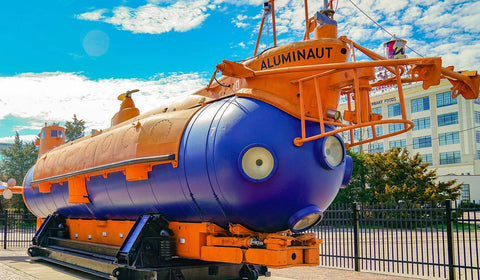
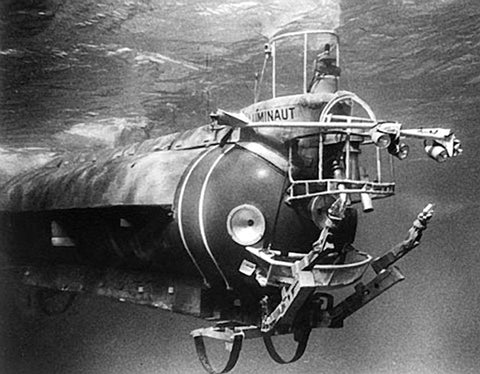
The result was a 50-foot-long, 80-ton vessel with a futuristic profile and the ability to dive to 15,000 feet. It looked like something from a sci-fi movie, but it was very real—and ready to make history.

Engineering That Changed the Game
The Aluminaut’s aluminum hull was a radical departure from tradition, offering three major advantages:
Lighter and Faster – With less weight to drag down, the vessel could maneuver more easily and use less energy.
Built to Last – Aluminum’s natural resistance to rust meant fewer repairs and longer missions.
Deep-Dive Ready – Special alloys and precision engineering allowed it to withstand the crushing pressures of the deep ocean, where water presses with thousands of pounds per square inch.
Inside, the sub bristled with tools: robotic arms for grabbing samples, advanced sonar for navigation, and a reinforced viewing dome to give scientists and engineers a front-row seat to the ocean’s hidden wonders.

Science Meets the Sea
For marine researchers, the Aluminaut was like a magic key to a locked world. It could glide over the ocean floor, hover above coral reefs, or drift through the pitch-black waters of the abyss.
Its missions collected rock and sediment samples, mapped uncharted underwater terrain, and studied deep-sea currents and ecosystems. It allowed scientists to witness creatures and geological formations that had never been seen by human eyes, bringing back not just data, but a sense of awe at the complexity of life below.

Secret Missions and Military Might
While the Aluminaut was a gift to science, it also had a more clandestine role. In 1966, it was called to assist in one of the most delicate recovery operations in naval history: retrieving a lost hydrogen bomb from the Mediterranean Sea after a mid-air collision between U.S. Air Force planes.
Operating under intense pressure—both literal and political—the vessel’s crew navigated treacherous waters to locate and help secure the weapon. The mission proved the Aluminaut could do more than explore; it could perform critical tasks in high-stakes military scenarios.
Its work also informed the Navy’s understanding of submarine stealth, underwater navigation, and deep-sea rescue techniques, influencing the design of military submersibles for decades to come.

Inspiring the Next Generation of Submersibles
Although the Aluminaut eventually retired, its influence is everywhere in modern ocean technology. The lessons learned from its aluminum hull, modular design, and deep-diving capabilities have shaped today’s remotely operated vehicles (ROVs) and autonomous underwater vehicles (AUVs).
Many of the sleek, nimble, and durable submersibles used for scientific exploration, oil and gas work, and undersea defense owe part of their DNA to the Aluminaut. It proved that thinking outside the box—sometimes outside the entire material—can spark breakthroughs that change industries.

Aluminaut: A Legacy Beneath the Waves
Today, the Aluminaut rests as a museum piece, a gleaming reminder of a time when daring engineering met oceanic mystery. Visitors can walk alongside its aluminum hull and imagine the moment when it slipped beneath the waves, heading into the unknown.
It’s more than a historical artifact—it’s a symbol of curiosity, courage, and the belief that the ocean’s secrets are worth chasing.
The Aluminaut was not just a submersible; it was a bold statement that innovation could rewrite the rules of exploration. By proving aluminum’s worth in the most extreme underwater conditions, it unlocked new possibilities for science, industry, and defense.
From recovering lost weapons to revealing the ocean’s hidden landscapes, the Aluminaut bridged the gap between imagination and reality. Its legacy continues to inspire engineers, scientists, and adventurers, reminding us that the deep sea—like human ingenuity—has no final frontier.