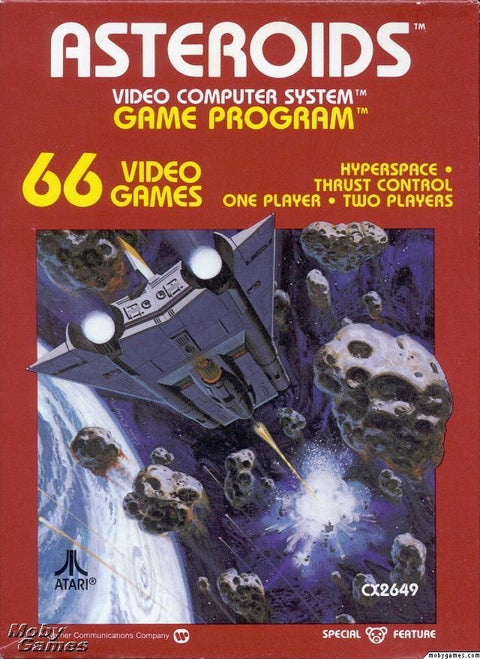
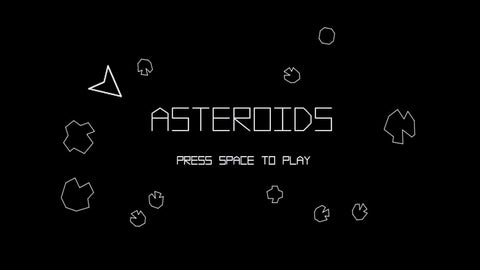
In the rapidly evolving world of video games, some titles are remembered not just for their gameplay, but for how they changed the game itself. Asteroids, originally released by Atari in arcades in 1979 and later ported to the Atari 2600 in 1981, is one of those iconic titles. With its simple vector graphics and deeply addictive mechanics, Asteroids didn't just entertain—it helped define what home console gaming could become.
This blog dives into what made Asteroids such a breakthrough, why it stood out during the golden age of gaming, and how it influenced the future of home entertainment.

From Arcade Hit to Living Room Classic
Before Asteroids ever touched a home console, it was already a smash hit in arcades. With a black-and-white vector display, no soundtrack, and a unique physics engine that simulated inertia and momentum, the arcade version offered a distinct gameplay experience that felt fresh and challenging.
When Atari brought Asteroids to the 2600, the stakes were high. Gamers were excited—but also skeptical. Could a game so dependent on smooth movement and precise shooting translate to the more limited capabilities of a home system?
The answer was a resounding yes. While the home version featured simplified visuals and chunkier controls, it managed to preserve the most important aspects of the original: tight gameplay, addictive replayability, and a sense of escalating tension as asteroids split and multiply. It became one of Atari’s top-selling titles and helped push the console into millions of living rooms worldwide.

A New Kind of Gameplay Loop
What set Asteroids apart from other early home console games was its gameplay loop. Instead of levels with clear beginnings and endings, Asteroids offered an endless, score-based challenge. Your only goal? Survive and rack up as many points as possible.
This introduced a key element of what we now call “replay value.” Every time a player hit “reset,” they weren’t restarting a story—they were entering a fresh attempt to beat their personal high score or outdo a sibling’s record. This competitive edge made Asteroids more than just a one-and-done experience. It became a staple of after-school hangouts and family gaming nights.
The concept of “just one more try” was cemented in the minds of early gamers, and it would go on to influence everything from mobile games to modern roguelikes.

Intuitive Yet Challenging Controls
The control scheme of Asteroids was deceptively simple: rotate your ship, thrust to move, shoot to destroy, and use hyperspace to escape tight situations (at your own peril). But that simplicity masked a steep learning curve.
Unlike games that featured static movement or character animations, Asteroids introduced players to physics-based gameplay. The ship would keep drifting unless you corrected its path, making movement feel real—and unpredictable.
This was a new concept for many home players, forcing them to adapt and improve their reflexes. It wasn’t about button-mashing. It was about timing, awareness, and spatial reasoning. For 1981, that was revolutionary in a home console context.
A Precursor to Modern Indie Game Design
Though created with limited technology, Asteroids is a perfect example of elegant minimalism—an approach that’s reemerged in modern indie game design. The clean black background, the minimalist shapes of asteroids and UFOs, and the emphasis on core gameplay over visuals are all ideas that today’s indie developers embrace.
Games like Geometry Wars, Super Stardust HD, and Downwell owe a debt to Asteroids for showing how pure mechanics can engage players just as much as complex narratives or high-end graphics.
In many ways, Asteroids was the original “easy to learn, hard to master” experience—a design philosophy that still drives successful titles today.

Lasting Cultural Impact
Beyond gameplay and design, Asteroids left a mark on gaming culture. Its pixelated spaceship and chunky asteroids became visual shorthand for retro gaming. Its high-score tables introduced players to the joy of competition and the agony of getting knocked off the top.
Even decades later, references to Asteroids show up in movies, fashion, and game design. It’s a symbol of gaming’s early optimism—of what could be created with imagination, a few pixels, and a joystick.

Asteroids: The Game That Launched a Thousand Ships
Asteroids may seem simple by today’s standards, but its influence is anything but. It brought physics-based gameplay into homes, introduced the infinite score-chasing loop, and helped prove that home console gaming could capture the spirit of the arcade.
More than four decades later, its legacy is still felt in the mechanics of modern games, the popularity of indie titles, and the fond nostalgia of players who remember drifting through space, dodging rocks, and chasing that elusive high score.
In the galaxy of home console gaming, Asteroids is one of the brightest stars.